Optical Computing Research
What?
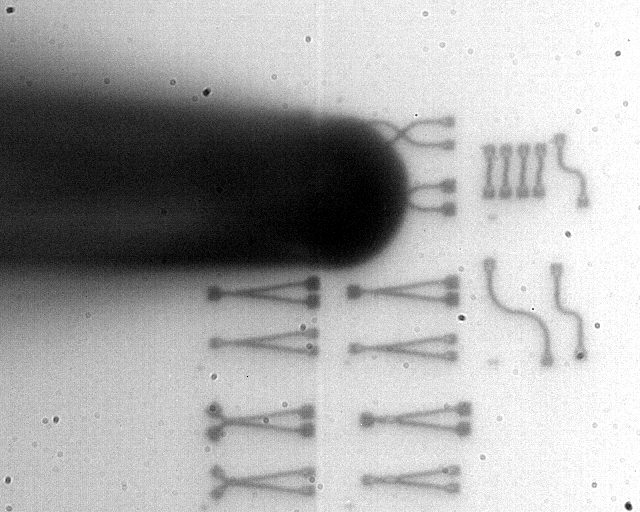
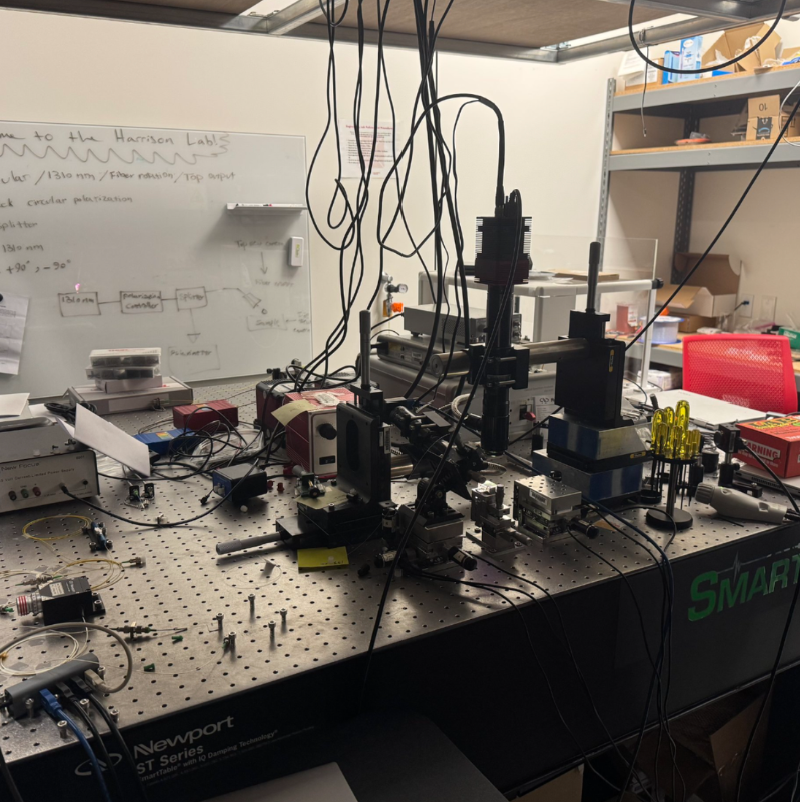
At Harrison Lab, I work on integrated photonic circuits for optical computing applications. I design digital logic gates and signal routing architectures using AutoCAD, applying mixed-signal design principles to photonic devices. On the experimental side, I engineered an isolation chamber that eliminated environmental interference, reducing faulty results by 84% and dramatically improving measurement reliability. I also develop MATLAB-based analysis tools to streamline testing, debug device behavior, and validate circuit performance. Essentially, I build the experimental infrastructure, characterize epsilon-near-zero materials and devices, and ensure our data accurately reflects performance.
Modern data networks face a critical bottleneck: while information travels as light through fiber optics, it must convert to electrical signals for any processing or routing decisions. These conversions create speed limitations, waste energy, and introduce latency. My work addresses this by developing photonic circuits that perform logic operations directly with light, eliminating electronic interconnects entirely. The epsilon-near-zero materials we're characterizing enable efficient nonlinear optical interactions, bringing practical all-optical computing closer to reality. This research aims to transform data centers and communication networks by replacing electronic bottlenecks with photonic solutions capable of handling exponentially growing information demands.
Why?
Most Recent Updates
As of January 2026, our research team has completed experimental data collection on waveguide crossings and beam splitters. We are currently conducting final data analysis to validate our designs by comparing measured performance against initial simulation results, with the goal of publishing our findings.